The single biggest mistake I see in puzzle-toy owner education is matching the puzzle difficulty to the dog's breed rather than to the dog's puzzle experience. A 6-month-old Border Collie given a Level 3 puzzle on day one will often fail, give up, and refuse the puzzle on day two. A 10-year-old Labrador given a Level 1 puzzle with some encouragement will often develop a new hobby. Progression matters. This guide walks through a structured difficulty progression used by trainers and applied behavior professionals, adapted for owners working on their own.
The Four Levels Explained
Most puzzle manufacturers use a 1 to 4 level system. The actual specifications vary slightly between brands, but a broadly consistent definition is:
- Level 1: Open-top or single-action puzzles where nosing or pawing reveals food. Example: Nina Ottosson Dog Hide N Slide.
- Level 2: Two-step puzzles requiring sliding or lifting. Example: Nina Ottosson Dog Brick.
- Level 3: Multi-step puzzles with compartments that must be accessed in sequence. Example: Nina Ottosson Dog Tornado.
- Level 4: Advanced combination puzzles requiring chained problem-solving. Example: Dog Casino, Nina Ottosson Dog Twister.
Our level 3 puzzles for smart dogs review covers the top products in that tier specifically.
How to Introduce Your Dog to Puzzles
Every dog, regardless of breed or previous activity, should start at Level 1. The first session is not about challenge; it is about building positive association. Place the puzzle on the floor in a quiet, familiar location. Load it with high-value treats (not kibble). Let the dog investigate without interference. If the dog solves the puzzle and gets the reward in under 60 seconds, you have the right starting difficulty.
If the dog walks away without investigating, or nose-bumps the puzzle and quits, the introduction is too abrupt. Pre-expose with some food placed loosely on top of the puzzle (not in the compartments) so the dog learns that the object is a food source before it has to solve anything. This simple step saves many dogs who would otherwise avoid puzzle work entirely.
When to Level Up
The criteria I use to decide whether a dog is ready for the next level are:
- The dog has solved the current-level puzzle consistently across 5 to 7 sessions.
- Solve time on the current puzzle has dropped by more than 50 percent from introduction.
- The dog shows clear confidence (body language relaxed, tail wagging during problem solving, returning to the puzzle immediately when placed).
- Solve time on the current puzzle is under 2 to 3 minutes, indicating the puzzle is now "too easy" to sustain engagement.
When all four criteria are met, the dog is ready to try the next level. Do not discard the lower-level puzzle; rotating a harder puzzle with a known-easier puzzle keeps both engagement and confidence high. Our Outward Hound puzzle toy review covers specific Level 2 and Level 3 picks.
When to Hold or Drop Down
Not every dog needs to progress linearly. Senior dogs, anxious dogs, and dogs recovering from recent stressful experiences often do better with a Level 1 or Level 2 puzzle used consistently rather than being pushed up. The goal of puzzle work is enrichment and cognitive satisfaction, not competitive problem solving. A dog who solves a Level 2 puzzle reliably and contentedly three times a week is in a better enrichment place than a dog who fails a Level 3 puzzle once a week.
Hold at the current level if: the dog solves occasionally but shows frustration (whining, walking away, flipping the puzzle over aggressively); the dog's body language during the session is tense rather than engaged; or the dog has experienced any major recent change (new home, loss of a family member, recent illness).
Drop down a level if: the dog has stopped engaging with the current puzzle for more than 2 consecutive sessions; the dog is exhibiting avoidance when the puzzle appears; or you notice any compulsive behaviors emerging (repetitive motion, redirected chewing). A brief return to an easier puzzle often restarts engagement within a week.
The Role of Food Type
The same puzzle can feel like a Level 2 or a Level 4 challenge depending on what you put inside. Loose kibble falls out with minimal effort. Wet food stuffed tight creates a much harder extraction task. Frozen wet food is harder still. Use this to modulate difficulty without buying new puzzles. This is also how owners extract 6 to 8 months of novelty from a small puzzle collection.
A useful progression within a single puzzle: start with loose kibble, then kibble topped with a light smear of peanut butter, then kibble mixed with wet food, then wet food layered and frozen. Each step adds roughly one level of difficulty to the same physical puzzle.
Session Length and Frequency
Most dogs fatigue on puzzle work at 10 to 15 minutes per session. End sessions while the dog is still engaged, not after they have walked away. Daily puzzle sessions often produce the best outcomes, though every-other-day works well for owners with tight schedules. A 2021 review in Applied Animal Behaviour Science by Wells noted that novel enrichment in short bouts produces measurable reductions in stress behaviors over 4 to 6 weeks, which maps closely to what practitioners observe in home use.
Puzzle Work for Breeds with High Cognitive Demand
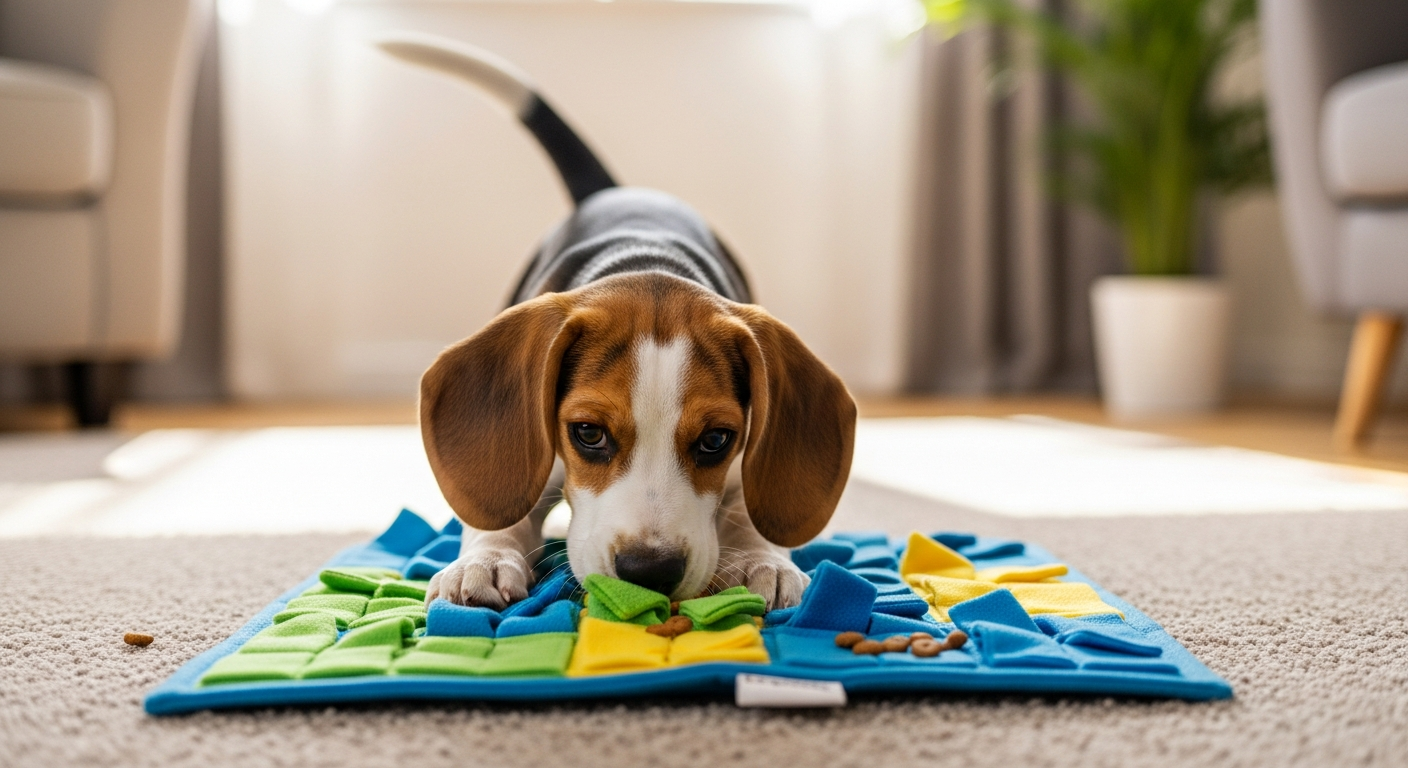
Border Collies, Australian Shepherds, Poodles, and other high-drive breeds benefit enormously from structured puzzle progression because physical exercise alone does not satisfy their cognitive needs. For these dogs, puzzle work is not a supplement to training; it is part of the training. A progressive puzzle program builds frustration tolerance, problem-solving flexibility, and the calm focus that supports other training. Our snuffle mat reviews and lick mat guide cover adjacent enrichment tools that pair well with puzzle progression for high-drive dogs.
Signs of a Genuinely Successful Puzzle Program
The best measures of a working puzzle progression are not the dog's speed of solving, but the broader behavioral effects: faster settling after walks, reduced destructive behavior during unsupervised time, improved focus during training sessions, better sleep quality, and owner reports of the dog "seeming more content." These cumulative effects take 4 to 6 weeks of consistent practice to emerge, which is why program consistency matters more than puzzle novelty.
The AKC's puzzle toy training guidance reinforces the progression principle and is worth sharing with owners new to puzzle enrichment.
Bottom Line
Puzzle difficulty is best progressed gradually, measured by session-specific criteria rather than owner assumption. Starting at Level 1 for every dog, using food-type variation to modulate difficulty within a puzzle, and moving up only when the dog has mastered and become bored with the current level produces the most durable enrichment outcomes. For specific product picks at each level, see our best dog puzzles of 2024 and the Outward Hound puzzle toy review.